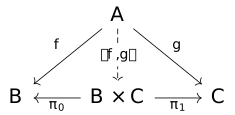
When working in a category, we can state many theorems compactly using commutative diagrams, such as this diagram for products:
In these diagrams, the objects are vertices in the diagram, and the morphisms are the arrows in the diagram (we typically omit identity morphisms and morphisms that are just compositions of other morphisms). Looking at the above diagram, we can equate the two paths from A to B and the two paths from A to C, and produce the equations \pi _0 \circ \langle f, g \rangle = f and \pi _1 \circ \langle f, g \rangle = g. We adopt the convention that dotted lines indicate uniqueness, meaning that, from the diagram above, we can also infer the law: \pi _0 \circ h = f \land \pi _1 \circ h = g \implies h = \langle f , g \rangle