Algebraicity and ideals [dt-005X]
DefinitionAlgebraicity [dt-0041]
A cpo is algebraic iff every element is the lub of its compact approximations. That is, a cpo D is algebraic iff for all x \in D,
- \mathop {\downarrow }(x) = \{ y \in \mathsf {K}(D) \mid y \sqsubseteq x \} is directed;
- x = \bigsqcup \mathop {\downarrow }(x)
Aside: Plotkin provides an equivalent definition of \omega -algebraic cpos in which directed sets are replaced with \omega -chains throughout. Hutton claims this is less appealing, as the definition speaks of an \omega -chain of compact approximations, rather than the directed set of such.
Example\omega -algebraic cpos [dt-0042]
Many standard examples of cpos are \omega -algebraic cpos: finite cpos, subsets \mathcal {P}(X) of a set X, partial functions \mathbb {N} \nrightarrow \mathbb {N} and submonoids of a monoid. In general, any cpo of subalgebras (e.g. subgroups of a group, subrings of a ring etc.) is \omega -algebraic. This is the origin of the terminology.
CounterexampleNon-algebraic cpo [dt-0043]
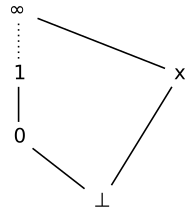
In the cpo on the right (seen also in § [dt-0040]), the element x is not the lub of its compact approximations. The only compact element that approximates x is \bot , and the least upper bound of the set \{\bot \} is just \bot , not x. That is: \mathop {\downarrow }(x) = \{\bot \} but: x \neq \bigsqcup \{\bot \}
TheoremNothing suddenly invented at infinity [dt-0045]
Let D and E be algebraic cpos. Then a function f : D \rightarrow E is continuous iff, for all x \in D: f(x) = \bigsqcup \ \{ f(a) \mid a \in \mathop {\downarrow }(x) \} In other words, in an algebraic cpo, continuous functions are completely defined by their behaviour for compact arguments.
This makes precise our earlier slogan in Definition [dt-001J], that continuous functions don't suddenly behave differently for infinite (i.e. non-compact) elements.
Proof.
Exercise [dt-0044]
Let f : D \twoheadrightarrow E be a continuous function between algebraic cpos. Define: G_f = \{ (a,b) \in \mathsf {K}(D) \times \mathsf {K}(E) \mid b \sqsubseteq f(a) \} Then for all x \in D, prove that: f(x) = \bigsqcup \ \{ b \mid (a,b) \in G_f \land a \sqsubseteq x \}
Solution.
This is powerful. For example, the continuous function f : \mathcal {P}(\mathbb {N}) \twoheadrightarrow \mathcal {P}(\mathbb {N}) on an uncountable cpo \mathcal {P}(\mathbb {N}) is completely determined by the countable relation G_f.
DefinitionDown-closure [dt-0047]
Given a poset Y, a set X \subseteq Y is down-closed iff, for all x \in X, any y \sqsubseteq x is in X.
DefinitionIdeal [dt-0048]
A set is ideal iff it is both down-closed and directed.
DefinitionIdeal completion [dt-0046]
The ideal completion of a set A, written sometimes as \mathsf {Id}(A), is the set of all ideal subsets of A, i.e.: \mathsf {Id}(A) = \{ X \subseteq A \mid X\ \text {is ideal}\}
TheoremRepresentation theorem for algebraic cpos [dt-0049]
Every algebraic cpo D is isomorphic to the ideal completion of its compact elements, ordered by subset inclusion. That is, \mathsf {Id}(K(D)) is an algebraic cpo such that D \simeq \mathsf {Id}(K(D)) .