Products [dt-002K]
Recall Construction [dt-000E], which showed that the product of two pointed posets is itself a pointed poset. In Exercise [dt-001X] you may also have shown that A \times B is also a cpo if A and B are cpos, with this definition for lubs: \bigsqcup X \; = \; \left (\bigsqcup \{ x \mid \exists y.\ (x,y) \in X \}, \bigsqcup \{ y \mid \exists x.\ (x,y) \in X \}\right ) This definition can be made a little more comprehensible by defining it in terms of the two projection operators for pairs:
DefinitionProjection operators for products [dt-0020]
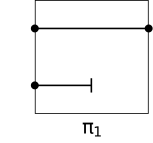
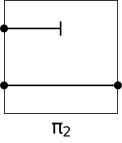
Destruction of pairs is captured by the two projection operators, defined as follows:
|
\begin {array}{lcl} \pi _0 : A \times B \rightarrow A & \qquad & \pi _1 : A \times B \rightarrow B \\ \pi _0(x, y) = x & & \pi _1(x, y) = y \\ \end {array} |
|
ConstructionProduct of cpos [dt-0021]
Given cpos A and B, the product A \times B is itself a cpo, ordered by (x,y) \sqsubseteq _{X \times Y} (x',y') \quad \text {iff} \quad x \sqsubseteq _X x' \land y \sqsubseteq _Y y' with bottom value \bot _{X \times Y} being (\bot _A, \bot _B). Least upper bounds are found by taking the lubs of each component:
\bigsqcup X \; = \; \left (\bigsqcup \{ \pi _0(x) \mid x \in X \}, \bigsqcup \{ \pi _1(x) \mid x \in X \}\right )TheoremContinuity of projection operations [dt-0022]
The projection functions \pi _0 and \pi _1 are continuous.
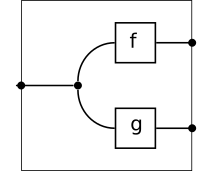
DefinitionThe split function [dt-0023]
TheoremContinuity of split [dt-0024]
For continuous functions f and g, the split function \langle f, g \rangle is continuous.
Proof.
Using the alternative characterisation of continuity:
- \langle f, g \rangle is monotonic. Let x \sqsubseteq y \in A. Then: \begin {array}{lclr} \langle f , g \rangle \ x & = & (f(x), g(x)) & \text {(def)}\\ & \sqsubseteq & (f(y), g(y)) & \text {(monotonicity of $f$,$g$)}\\ & = & \langle f , g \rangle \ y & \text {(def)} \end {array}
- \langle f , g \rangle preserves lubs of directed sets. Let X \subseteq A be directed. Then: \begin {array}{lclr} \langle f , g \rangle \ (\bigsqcup X) & = & (f(\bigsqcup X), g(\bigsqcup X)) & \text {(def)}\\ & = & (\bigsqcup \{ f(x) \mid x \in X \}, \bigsqcup \{ g(x) \mid x \in X \}) & \text {(continuity of $f$,$g$)}\\ & = & \bigsqcup \{ \langle f , g \rangle \ x \mid x \in X \} & \text {(def)} \end {array}
These building blocks can be used to make many functions on products (thereby ensuring continuity):
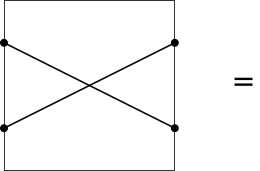
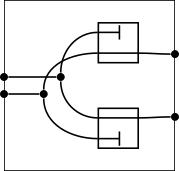
DefinitionThe \mathit {swap} function [dt-0025]
 |
|
\begin {array}{l}\mathit {swap} : A \times B \rightarrow B \times A \\ \mathit {swap} = \langle \pi _1 , \pi _0 \rangle \end {array} |
DefinitionProduct of functions [dt-0026]
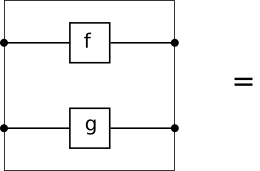
Given f : A \rightarrow C and g : B \rightarrow D, we overload the \times operator for products to denote the combined function f \times g : A \times B \rightarrow C \times D, given below:
 |
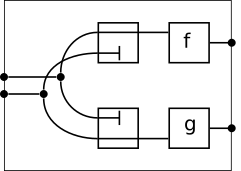 |
\begin {array}{l} f \times g : A \times B \rightarrow C \times D \\ f \times g = \langle f \circ \pi _0 , g \circ \pi _1 \rangle \end {array} |
Exercise [dt-002G]
Express the function \mathit {juggle} (a, (b,c)) = ((a,b),c) using just our primitive combinators for projection and split.
Solution.
\mathit {juggle} \triangleq \langle \langle \pi _0 , \pi _0 \circ \pi _1 \rangle , \pi _1 \circ \pi _1 \rangle
Pictorial Properties [dt-0027]
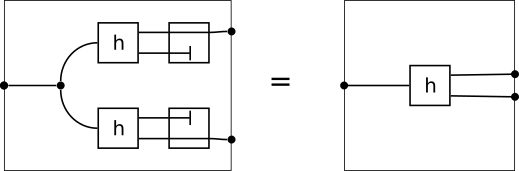
The following properties of our projection and split functions follow from the pictorial reasoning we see on the right:
| \pi _0 \circ \langle f , g \rangle = f | 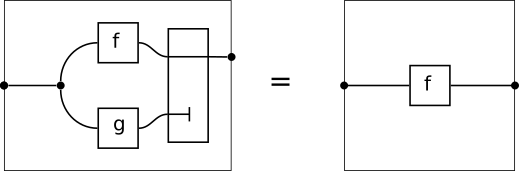 |
| \pi _1 \circ \langle f , g \rangle = g | 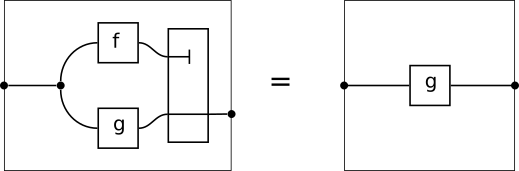 |
| \langle \pi _0 \circ h , \pi _1 \circ h \rangle = h |
 |
Exercise [dt-0028]
Prove that the three properties in § [dt-0027] are equivalent to the universal property for products
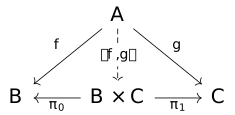
(\pi _0 \circ h = f \land \pi _1 \circ h = g)\ \text {iff}\ h = \langle f , g \rangleSolution.
Showing in both directions:
- The three properties follow from the universal property: The first two properties follow from the universal property where h is set to \langle f , g \rangle . The third property follows from the universal property where f is set to \pi _0\circ h and g is set to \pi _1\circ h.
- The universal property follows from the universal property: In the \Rightarrow direction of the universal property follows from the third property, and the \Leftarrow direction follows from the first two.
DefinitionUniversal property for cpo products [dt-0029]
As commuting diagram on the category \mathbf {Cpo}:
AsideCategory theory [dt-002A]
DefinitionCategory [dm-000G]
A category Cconsists of a collection of things (objects) and a collection of arrows between these things (morphisms). If there is a morphism A \xrightarrow {f} B and a morphism B \xrightarrow {g} C, we also have the composed morphism A \xrightarrow {g \circ f} C. This composition operator must be associative. Additionally each object X has an identity morphism X \xrightarrow {\mathsf {id}_X} X, such that for an arrow X \xrightarrow {a} Y, a \circ \mathsf {id}_X = \mathsf {id}_Y \circ a = a.
ExampleThe category \mathbf {Set} [dm-000H]
ExampleThe category \mathbf {Rel} [dm-000I]
ExampleThe category \mathbf {Cpo} [dt-002B]
The category \mathbf {Cpo} is the category where the objects are cpos, the morphisms are continuous functions between these cpos, composition is function composition ((g \circ f)(x) \triangleq g(f(x))) and identity is just the identity function \lambda x. x.
DefinitionFunctor [dm-000J]
A functor F from a category \mathbf {C} to a category \mathbf {D} consists of an object mapping that maps objects of \mathbf {C} to objects of \mathbf {D}, and a morphism mapping that maps morphisms of \mathbf {C} to morphisms of \mathbf {D} such that:
- For each A \xrightarrow {m} B in \mathbf {C}, we have a morphism F(A) \xrightarrow {F(m)} F(B) in \mathbf {D}.
- For each object A in \mathbf {C}, the equation F(\mathsf {id}_A) = \mathsf {id}_{F(A)} holds in \mathbf {D}.
- For a pair of morphism A \xrightarrow {f} B \xrightarrow {g} C in \mathbf {C}, the equation F (g \circ f) = F(g) \circ F(f) holds in \mathbf {D}.
ExampleThe category \mathbf {Cat} [dm-000K]
The category \mathbf {Cat} is the category where the objects are themselves (small) categories, the morphisms are structure-preserving maps between these categories, i.e., functors.
Commutative diagrams [dm-000L]
When working in a category, we can state many theorems compactly using commutative diagrams, such as this diagram for products:
CorollaryDerived properties of cpo products [dt-002C]
The universal property is called such because all the familiar properties of products follow from it – thinking in pictures helps to see how (Indeed, the universal property characterises products up to isomorphism):
- \pi _0 \circ (f \times g) = f \circ \pi _0
- \pi _1 \circ (f \times g) = g \circ \pi _1
- (f \times g) \circ \langle h , i \rangle = \langle f \circ h, g \circ i \rangle
- \langle f , g \rangle \circ h = \langle f \circ h, g \circ h \rangle
- \mathsf {id}_A \times \mathsf {id}_B = \mathsf {id}_{A \times B} \quad (*)
- (f \circ g) \times (h \circ i) = (f \times h) \circ (g \times i) \quad (**)
These last two statements (*) and (**) show that \times is a bifunctor on the category \textbf {Cpo}, i.e., a functor \textbf {Cpo} \times \textbf {Cpo} \rightarrow \textbf {Cpo}.
Exercise [dt-002I]
Show using the universal property that \langle f, g \rangle \circ h = \langle f \circ h , g \circ h \rangle
Solution.
Isomorphisms for cpo products [dt-002D]
DefinitionCpo isomorphism [dt-002E]
An isomorphism between two cpos A and B is a bijection f between A and B such that f preserves the cpo structure, i.e., that f and f^{-1} are continuous.
We say two cpos A and B are isomorphic, written A \simeq B, iff an isomorphism exists between them.
TheoremCommutative monoid structure for cpos [dt-002H]
Cpos form a commutative monoid "up to isomorphism" under \times and \mathbf {1} (the cpo consisting of only one element \bot ). That is, for all cpos A, B and C:
- A \times \mathbf {1} \simeq A
- A \times (B \times C) \simeq (A \times B) \times C
- A \times B \simeq B \times A
Proof.
The isomorphisms required are the projection \pi _0, the \mathit {juggle} function from Exercise [dt-002G], and the swap function.
DefinitionThe set of continuous functions [dt-002F]
Let A \twoheadrightarrow B denote just the continuous functions from cpo A to cpo B: A \twoheadrightarrow B\; \triangleq \; \{ f : A \rightarrow B \mid f\ \text {is continuous} \}
Theorem [dt-002J]
There is an isomorphism between pairs of continuous functions and continuous functions that output pairs: (A \twoheadrightarrow B) \times (A \twoheadrightarrow C)\; \simeq \; (A \twoheadrightarrow (B \times C))
Proof.
Upshot.
Because we have the functor \times on \textbf {Cpo} that satisfies the properties of products described above, the category \textbf {Cpo} therefore has binary products.