Flat domains and information ordering [dt-0009]
The bottom value [dt-000A]
Following Scott, we introduce a special bottom value \bot to our semantic domains. \bot \ \text {represents}\ \begin {cases}\text {an undefined value;}\\\text {an error value;}\\\text {a \emph {non-terminating} computation.} \end {cases}
DefinitionFlat domain [dt-0008]
Given a set X, the flat domain (or lifted set) X_\bot is just the set X \cup \{ \bot \} (where \bot \notin X).
DefinitionInformation ordering [dt-000B]
An information ordering is a partial order on denotations, written a \sqsubseteq b. This indicates that b is approximated by, or carries more information than, or is more well-defined than a. Naturally, the bottom value, being totally uninformative, is always the least element in this ordering.
ExampleInformation ordering for flat domains [dt-000C]
Consider a flat domain X_\bot . There is a natural information ordering \sqsubseteq on X_\bot :
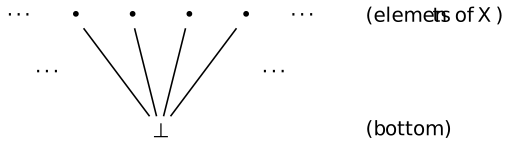
Formally, we say x \sqsubseteq y iff (x = y \lor x = \bot ).
Warning.
Don't confuse the information ordering on numbers, i.e. \sqsubseteq on \mathbb {Z}_\bot , with the numerical ordering \leq on \mathbb {Z}. We know 0 \leq 1, but 0 and 1 are not comparable in our flat information ordering.