From \textbf {Cpo} to \textbf {Cpo}^{\textbf {R}} [dt-0052]
ProblemContravariance in the function arrow [dt-0053]
We cannot get morphism mappings in the category \textbf {Cpo} as easily as § [dt-0050] when our object mapping makes use of the function operators \mathbin {\circ \hspace{-0.4em}\twoheadrightarrow } and \twoheadrightarrow , as they are contravariant in their first argument. This means the functor that they extend to is not \textbf {Cpo} \rightarrow \textbf {Cpo} but \textbf {Cpo}^\textsf {op} \rightarrow \textbf {Cpo}, where \textbf {Cpo}^\textsf {op} is the dual category of \textbf {Cpo}. The morphisms end up the wrong way around.
As an example, consider \mathcal {F}(X) = X\twoheadrightarrow \mathbb {Z}_\bot . Then, recalling the morphism mapping of the \twoheadrightarrow functor: \dfrac {f : A \twoheadrightarrow B \quad g : C\twoheadrightarrow D}{f\twoheadrightarrow g : (B\twoheadrightarrow C)\twoheadrightarrow (A\twoheadrightarrow D)} We can generate a morphism mapping for \mathcal {F}: \mathcal {F}(f)\; =\; f\twoheadrightarrow \mathsf {id}_{\mathbb {Z}_\bot }\; =\; (\lambda h.\ \mathsf {id}_{\mathbb {Z}_\bot }\circ h \circ f)\; = \;(\lambda h.\ h \circ f) However, this mapping has the wrong type. For f : A\twoheadrightarrow B, then \mathcal {F}(f) : (B\twoheadrightarrow \mathbb {Z}_\bot ) \rightarrow (A\twoheadrightarrow \mathbb {Z}_\bot ), which is \mathcal {F}(B)\twoheadrightarrow \mathcal {F}(A), not the required \mathcal {F}(A)\twoheadrightarrow \mathcal {F}(B). This is because the generated functor is contravariant, not covariant.
Exercise [dt-005O]
Show that, in contrast to \mathcal {F}(X) = X\twoheadrightarrow \mathbb {Z}_\bot from Problem [dt-0053], the mapping \mathcal {G}(X) = \mathbb {Z}_\bot \twoheadrightarrow X can be extended to continuous functions giving a covariant endofunctor on \textbf {Cpo}.
Given a continuous function f : A \twoheadrightarrow B, we must produce a continuous function \mathcal {F}(f) : (\mathbb {Z}_\bot \twoheadrightarrow A) \twoheadrightarrow (\mathbb {Z}_\bot \twoheadrightarrow B), defined as follows:
\mathcal {F}(f)(g)(x) = f \circ g(x)
Composition of continuous functions preserves continuity. The functor laws can be shown straightforwardly.
Solution.
DefinitionRetraction pair [dt-0054]
A retraction pair (f,g) on cpos A to B consists of two continuous functions A \xtofrom [g]{f} B such that:
- g \circ f = \mathsf {id}_A\quad (i.e. \forall x \in A.\ g(f(x)) = x )
- f \circ g \sqsubseteq \mathsf {id}_B\quad (i.e. \forall y \in B.\ f(g(y)) \sqsubseteq y )
Retraction pairs are weakenings of isomorphisms. Intuitively, going A \twoheadrightarrow B\twoheadrightarrow A, all information is preserved due to requirement 1, but going B\twoheadrightarrow A\twoheadrightarrow B, we may lose some information (hence the use of \sqsubseteq in requirement 2).
ExampleExamples and counterexamples of retraction pairs [dt-0055]
Here are two examples of retraction pairs:
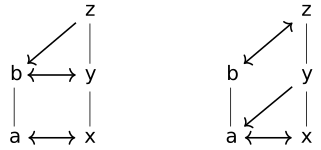
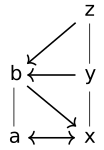
The following, however, are not retraction pairs A \xtofrom [g]{f} B:
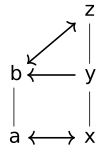
(y \mapsto b \mapsto z but z \not \sqsubseteq y)
(b \mapsto x \mapsto a but a \neq b)
DefinitionComposition of retraction pairs [dt-0056]
We can compose retraction pairs by composing their embedding and projection:

CorollaryDerived products of retraction pairs [dt-0057]
It follows from the definition of retraction pairs that, for a pair \xtofrom [g]{f}:
- f and g are strict, i.e. f(\bot ) = \bot and g(\bot ) = \bot .
- g is uniquely determined by f and vice-versa, so if another retraction pair \xtofrom [g']{f} exists, then g = g'. To see why, remember that f and g must be continuous and therefore monotonic.
- A is isomorphic to the range of f, i.e. A \simeq \{ f(x) \mid x \in A\} \subseteq B.
DefinitionThe category \textbf {Cpo}^\textbf {R} [dt-0058]
The category \textbf {Cpo}^\textbf {R} is the category where the objects are cpos, the morphisms are retraction pairs, composition is as in Definition [dt-0056] and identity is just the retraction pair A \xtofrom [\lambda x. x]{\lambda x. x} A.
DefinitionInformation ordering in \textbf {Cpo}^\textbf {R} [dt-0059]
The third point in Corollary [dt-0057] suggests a notion of approximation, or information ordering, for cpos. Rather than say, as we did in § [dt-004O], that for cpos A and B, A \sqsubseteq B iff there exists a continuous function A\twoheadrightarrow B, we now say:
Generalising to \textbf {Cpo}^\textbf {R} [dt-005A]
All of our other notions for \textbf {Cpo} naturally generalise to a setting with retraction pairs \textbf {Cpo}^\textbf {R}: least elements, \omega -chains, upper bounds, colimits, cocontinuous endofunctors and so on.
Definition\omega -chains of cpos in the category \mathbf {Cpo}^\textbf {R} [dt-005C]
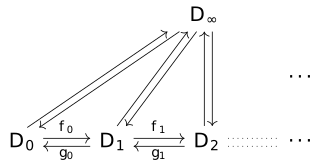
An \omega -chain of cpos in the category \mathbf {Cpo}^\textbf {R} consists of a family of cpos \{D_i \mid i \in \mathbb {N} \}, together with a family of retraction pairs D_i \xtofrom [g_i]{f_i} D_{i+1}, shown below:

DefinitionEndofunctors on \textbf {Cpo}^\textbf {R} [dt-005D]
An endofunctor on the category \textbf {Cpo}^\textbf {R} is a functor \textbf {Cpo}^\textbf {R} \rightarrow \textbf {Cpo}^\textbf {R}, i.e. a mapping \mathcal {F} on cpos together with a mapping \mathcal {F} on retraction pairs, such that:
- If (f,g) is a retraction pair A \xtofrom [g]{f} B then \mathcal {F}(f,g) is a retraction pair \mathcal {F}(A)\xtofrom []{} \mathcal {F}(B)
- \mathcal {F}(\mathsf {id}_A : A\xtofrom []{} A) = \mathsf {id}_{\mathcal {F}(A)} : \mathcal {F}(A)\xtofrom []{} \mathcal {F}(A)
- \mathcal {F}(f \circ g) = \mathcal {F}(f) \circ \mathcal {F}(g) (where \circ is composition of retraction pairs)
DefinitionUpper bounds in the category \mathbf {Cpo}^\mathbf {R} [dt-005G]
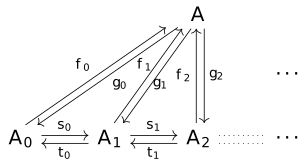
A cpo A is an upper bound of an \omega -chain of cpos A_i in the category \mathbf {Cpo}^\textbf {R} if there is a family of retraction pairs A_i \xtofrom [g_i]{f_i} A such that the following diagram commutes (i.e. for all i \in \mathbb {N}, (f_i, g_i) = (f_{i+1},g_{i+1}) \circ (s_i,t_i), where \circ is composition of retraction pairs):
DefinitionColimits in the category \mathbf {Cpo}^\mathbf {R} [dt-005F]
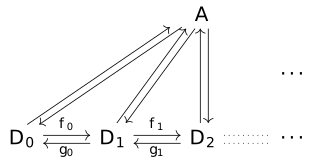
A cpo A is the colimit of an \omega -chain of cpos A_i if is both an upper bound, i.e. there exists retraction pairs (f_i,g_i) : A_i \xtofrom []{} A, and for any other upper bound B, for which there will exist retraction pairs (m_i,n_i) : A_i \xtofrom []{} B, there exists a unique retraction pair A \xtofrom [k']{k} B such that (m_i,n_i) = (k,k') \circ (f_i,g_i) for all i \in \mathbb {N}, where \circ is composition of retraction pairs. Viewed diagramatically, it is the same as Definition [dt-004S] where continuous functions are replaced by retraction pairs.
DefinitionCocontinuous endofunctors on \textbf {Cpo}^\textbf {R} [dt-005E]
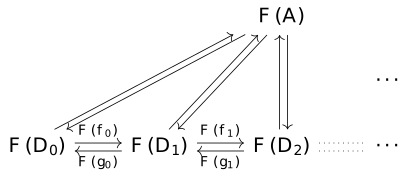
An endofunctor \mathcal {F} is cocontinuous iff it preserves colimits of \omega -chains of cpos. That is, given a chain where A is a colimit:
Extending cpo Mappings to endofunctors on \textbf {Cpo}^\mathbf {R} [dt-005I]
If \mathcal {F} is a mapping on cpos built up from basic cpos using the constructions \times , \otimes , +, \oplus , (\cdot )_\bot , as well as \twoheadrightarrow and \mathbin {\circ \hspace{-0.4em}\twoheadrightarrow }, then \mathcal {F} extends to a (covariant!) cocontinuous functor on \textbf {Cpo}^\mathbf {R}. We shall detail the construction for products and functions here, but the other constructions are all similar.
Definition\times operation for retraction pairs [dt-005J]
Given two retraction pairs (f,g) and (h,i), our retraction pair for their product is just the product of their embedding and projection, i.e. (f \times h, g \times i), using our product operation on continuous functions: \dfrac {A \xtofrom [g]{f} B\quad C \xtofrom [i]{h} D}{A\times C \xtofrom [g \times i]{f \times h} B \times D}
Definition\twoheadrightarrow operation for retraction pairs [dt-005K]
We are given two retraction pairs A \xtofrom [g]{f} B and C \xtofrom [i]{h} D. To define a suitable covariant functor, we define our morphism mapping in terms of our \twoheadrightarrow operation on continuous functions: (f,g) \twoheadrightarrow (h,i) \; \triangleq \; (g\twoheadrightarrow h, f \twoheadrightarrow i) Note that the positions of f and g are swapped in the above definition. \dfrac {A \xtofrom [g]{f} B \quad C \xtofrom [i]{h} D}{A \twoheadrightarrow C \xtofrom [f \twoheadrightarrow i]{g \twoheadrightarrow h} B \twoheadrightarrow D} Unlike with the category \textbf {Cpo}, this functor is not contravariant but covariant: Note the positions of A and B are not swapped!
TheoremFixed point theorem for endofunctors on \textbf {Cpo}^\textbf {R} [dt-005B]
Every cocontinuous endofunctor \mathcal {F} on \mathbf {Cpo}^\textbf {R} has a least fixed point, given by the colimit of the ascending \omega -chain:

ConstructionThe colimit D^\infty [dt-005H]
Given an \omega -chain:
The colimit (or inverse limit) is the cpo of \omega -tuples: D_\infty \; \triangleq \; \left \{ (x_0, x_1, \dots ) \mid x_i \in D_i \land x_i = g_i(x_{i+1}) \right \} That is, it is countable sequence of elements, one for each domain D_i, where each element is consistent with earlier elements.
Ordering: The ordering is the pointwise ordering of products, naturally generalised to \omega -tuples. Under this ordering, D_\infty is a cpo. In fact if each D_i is a Scott domain, so is D_\infty .
We shall prove that D_\infty is an upper bound of the \omega -chain. Proof that it is the least upper bound is straightforward but tedious, and is omitted. We must construct a family of retraction pairs:
\left \{ D_i \xtofrom [\theta _{\infty ,i}]{\theta _{i,\infty }} D_\infty \middle |\;\; i \in \mathbb {N}\;\; \right \}
such that the following diagram commutes:
Proof.