Functions [dt-002Z]
Previously, such as in Example [dt-001U], we already implicitly assumed that the set of continuous functions on cpos A \twoheadrightarrow B is itself a cpo. In this section, we will formalise this construction.
ConstructionThe cpo of functions [dt-002L]
If A and B are cpos, the set of continuous functions A \twoheadrightarrow B is a cpo under the pointwise ordering: f \sqsubseteq g\;\; \text {iff}\;\; \forall a \in A.\ f(a) \sqsubseteq g(a) The intuition of this ordering in terms of information is that we increase the information content of a function overall by increasing the information content of any (or many) argument values. To prove this, we must show:
- A \twoheadrightarrow B has a least element. \bot _{A \twoheadrightarrow B} is the constant function that returns \bot _B, i.e. \lambda a.\ \bot _B.
- \bigsqcup X exists for all directed X \subseteq A \twoheadrightarrow B. Our lub of a set of continuous functions \bigsqcup X is the function \Phi where: \Phi (a) = \bigsqcup \{ f(a) \mid f \in X\}
We must show a number of properties of this lub \Phi . Specifically:
- \bigsqcup \{ f(a) \mid f \in X\} exists in B.
Proof.
We want to show that the set \{ f(a) \mid f \in X\} is directed. Take two values g(a), h(a) \in \{ f(a) \mid f \in X\}. Since X is directed, there exists a function k \in X such that g \sqsubseteq k and h \sqsubseteq k. By applying the definition of \sqsubseteq for functions above, we have g(a) \sqsubseteq k(a) and h(a) \sqsubseteq k(a). Thus k(a) is an upper bound of these two values g(a), h(a), and thus \{ f(a) \mid f \in X\} is directed, and thus its lub exists since B is a cpo. - \Phi (a) = \bigsqcup \{ f(a) \mid f \in X \} is continuous.
Proof.
Using the alternative characterisation of continuity
\begin {array}{lclr} \Phi (\bigsqcup Y) &=& \bigsqcup \{ f(\bigsqcup Y) \mid f \in X \} & \text {(defn. $\Phi $)}\\ & = & \bigsqcup \{\bigsqcup \{ f(y) \mid y \in Y \} \mid f \in X \} & \text {($f$ is continuous)}\\ & = & \bigsqcup \{\bigsqcup \{ f(y) \mid f \in X \} \mid y \in Y \} & \text {(swap lubs)}\\ & = & \bigsqcup \{ \Phi (y) \mid y \in Y \} & \text {(defn. $\Phi $)}\\ \end {array} Monotonicity is similar to prove. - \Phi is an upper bound for X \subseteq A \twoheadrightarrow B.
Proof.
Let g \in X. Then for any a \in A we have g(a) \in \{ f(a) \mid f \in X\}. Now, by 2a and lubs, we have g(a) \sqsubseteq \bigsqcup \{ f(a) \mid f \in X \}, which by the definition of \Phi gives g(a) \sqsubseteq \Phi (a). Hence, by the definition of \sqsubseteq on functions, we can conclude g \sqsubseteq \Phi . - \Phi is the least upper bound for X.
Proof.
Let g \in A \twoheadrightarrow B be an upper bound for X \subseteq A \twoheadrightarrow B. Then (using \sqsubseteq on functions) g(a) is an upper bound for \{f(a) \mid f \in X\} for all a \in A. Now, by 2a and lubs, we have \bigsqcup \{f(a) \mid f \in X\} \sqsubseteq g(a), i.e. \Phi (a) \sqsubseteq g(a), which, by the definition of \sqsubseteq on functions, allows us to conclude \Phi \sqsubseteq g.
- \bigsqcup \{ f(a) \mid f \in X\} exists in B.
ExampleThe space \mathbb {B}_\bot \twoheadrightarrow \mathbb {B}_\bot [dt-002M]
 At each step "upwards" on this
Primitive functions for functions [dt-002P]
DefinitionThe \mathit {apply} function [dt-002N]
The \mathit {apply} function simply applies a given function to a given argument: \begin {array}{l} \mathit {apply} : ((A \twoheadrightarrow B) \times A) \twoheadrightarrow B\\ \mathit {apply} (f, a) = f(a) \end {array}
Exercise [dt-002Q]
Show that \mathit {apply} is continuous.
Hint: A function f : A \times B \rightarrow C is continuous iff it is continuous in each argument separately, i.e., iff \forall a \in A.\ f(a,\cdot ) : B \rightarrow C is continuous, and \forall b \in B.\ f(\cdot ,b) : A \rightarrow C is continuous.
Solution.
First showing \mathit {apply}(f,\cdot ) is continuous for some continuous f : A \twoheadrightarrow B, using the alternative characterisation
- \mathit {apply}(f,\cdot ) is monotonic: Given a, b \in A where a \sqsubseteq b, we can see that \mathit {apply}(f,a) = f(a) \sqsubseteq f(b) = \mathit {apply}(f,b) by the monotonicity of f.
- \mathit {apply}(f,\cdot ) preserves lubs: Given a directed X \subseteq A, we can see that \mathit {apply}(f,\bigsqcup X) = f(\bigsqcup X) = \bigsqcup \{f(x) \mid x \in X\} = \bigsqcup \{\mathit {apply}(f,x) \mid x \in X\} follows from the continuity of f.
- \mathit {apply}(\cdot ,a) is monotonic: Given f, g \in A \twoheadrightarrow B where f \sqsubseteq g, we can see that \mathit {apply}(f,a) = f(a) \sqsubseteq g(a) = \mathit {apply}(g,a) by the pointwise ordering of functions.
- \mathit {apply}(\cdot ,a) preserves lubs: Given a directed X \subseteq A \twoheadrightarrow B, we can see that \mathit {apply}(\bigsqcup X, a) = \left (\bigsqcup X\right )(a) = \bigsqcup \{f(a) \mid f \in X\} = \bigsqcup \{\mathit {apply}(f,a) \mid f \in X\} follows from the lub definition for functions.
DefinitionThe \mathit {curry} function [dt-002O]
The function \mathit {curry} transforms a function that takes two arguments all at once (as a product) into a function that takes the arguments one at a time. That is, if f : A \times B \twoheadrightarrow C then: \begin {array}{l} \mathit {curry}(f) : A \twoheadrightarrow (B \twoheadrightarrow C)\\ \mathit {curry}(f)(a)(b) = f(a, b) \end {array}
TheoremContinuity of \mathit {curry} [dt-002S]
- \mathit {curry} is continuous on A \times B \twoheadrightarrow C.
- \mathit {curry}(f), given continuous f : A \times B \twoheadrightarrow C, is continuous on A.
- \mathit {curry}(f)(a), given continuous f : A \times B \twoheadrightarrow C and a \in A, is continuous on B.
Exercise [dt-002R]
What is the common (functional programming) name for \mathit {apply} \circ (f \times \mathsf {id})?
\mathit {uncurry}Solution.
DefinitionUniversal property for functions [dt-002T]
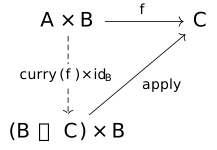
TheoremThe currying isomorphism [dt-002U]
Proof.
Follows from the universal property for functions when set up with the isomorphism from curry and its inverse, the function in Exercise [dt-002R].
RemarkWhy the function arrow is not a covariant bifunctor [dt-002V]
For the \twoheadrightarrow operator on cpos (Definition [dt-002F]) to be the object mapping for a bifunctor \textbf {Cpo} \times \textbf {Cpo} \rightarrow \textbf {Cpo} like \times is (see Corollary [dt-002C]), we would need to define a morphism mapping f \twoheadrightarrow g that, given two functions f : A \twoheadrightarrow B and g : C \twoheadrightarrow D, gives a function (A \twoheadrightarrow C) \twoheadrightarrow (B \twoheadrightarrow D). But such a function is not implementable: \begin {array}{l} f \twoheadrightarrow g : (A \twoheadrightarrow C) \twoheadrightarrow (B \twoheadrightarrow D) \\ (f \twoheadrightarrow g)(h)(b) =\ \textcolor {red}{???}\\ \end {array} In the above hole \textcolor {red}{???}, h : A \twoheadrightarrow C and b \in B. Given the value b \in B, none of our functions f, g or h take elements of B, so there would be no way to produce the D value required. This is because our function f : A \twoheadrightarrow B goes the wrong way. If f were a function B \twoheadrightarrow A, things would be a lot easier.
DefinitionDual category [dm-000Q]
The function arrow is a bifunctor [dt-002W]
The operator \twoheadrightarrow introduced in Definition [dt-002F] is is the object mapping for a binary functor: (\twoheadrightarrow ) : \mathbf {Cpo}^\mathsf {op} \times \mathbf {Cpo} \rightarrow \mathbf {Cpo} The category \mathbf {Cpo}^\mathsf {op} is the dual category to \mathbf {Cpo}.
Thus, a morphism A \xrightarrow {m} B in the category \mathbf {Cpo}^\mathsf {op} is a continuous function m : B \twoheadrightarrow A. Thus, the morphism mapping for our functor must take two functions f : B \twoheadrightarrow A (the morphism from \mathbf {Cpo}^\mathsf {op}) and g : C \twoheadrightarrow D (the morphism from \mathbf {Cpo}), and produce (A \twoheadrightarrow C) \twoheadrightarrow (B \twoheadrightarrow D). As with products, we will overload the \twoheadrightarrow notation for this mapping as well.
DefinitionMorphism mapping for \twoheadrightarrow [dt-002X]
Given f : B \twoheadrightarrow A and g : C \twoheadrightarrow D, we have: \begin {array}{l} f \twoheadrightarrow g : (A \twoheadrightarrow C) \twoheadrightarrow (B \twoheadrightarrow D)\\ f \twoheadrightarrow g = \mathit {curry}\ (g \circ \mathit {apply} \circ (\mathsf {id} \times f))\\[2em] \text {(or, operationally:)}\\ (f \twoheadrightarrow g)(h) = g \circ h \circ f\\ \end {array}
Theorem [dt-002Y]
The two functor laws follow as a consequence of the universal property for functions:
- \mathsf {id}_A \twoheadrightarrow \mathsf {id}_B = \mathsf {id}_{A \twoheadrightarrow B}
- (f \circ g) \twoheadrightarrow (h \circ i) = (g \twoheadrightarrow h) \circ (f \twoheadrightarrow i)
Upshot.
Our category \textbf {Cpo} has exponentials.