Weeknotes 2026-W17 [2026-W17]
- April 26, 2026
- Liam O'Connor
This week was the first week back teaching, but we are off to a good start, I think.
Deep result in monitoring theory [loc-0046]
- April 26, 2026
- Liam O'Connor
My student Kai Phan was absolutely on fire this week. About five times I threw out a few idle conjectures I had, and within hours she'd come back with a proof or a counterexample. We made more progress in one week than I had thinking about this stuff for months.
It's well known in the world of runtime verification that the class of monitorable properties (by which I mean the definition used by Bauer, where no monitor will get into an "ugly" state where no informative answer is possible) is larger than the set of safety or guarantee properties, or their boolean combinations (called obligation properties or \Delta _2).
What Kai showed recently is that all monitorable properties are indistinguishable by any monitor from an obligation property. This shows that a lot of the monitorability classes we find in the literature are making a distinction from standard sets in \Delta _2 that is only observable at infinity anyway. So the "largeness" of the monitorability classes is illusory, and obligation properties are all you need.
The proof has been mechanised in Isabelle/HOL, and we have a number of other supporting contributions that I think will make a good paper for POPL or LICS. I'm very proud of Kai's progress so far! I think this result will reinforce her plan for her thesis, which is to semantically tackle revocable monitors (i.e. monitors that can change their mind). Seeing as the difference hierarchy is contained at all finite levels in \Delta _2, we should have an easy time justifying restricting to \Delta _2 properties now.
Coro Concert: Radiant Dawn [loc-0045]
- April 26, 2026
- Liam O'Connor
Coro's concert has now been officially announced. Please buy tickets as soon as you can! The venue is my usual All Saints Ainslie church so the acoustic is good but seating is limited.
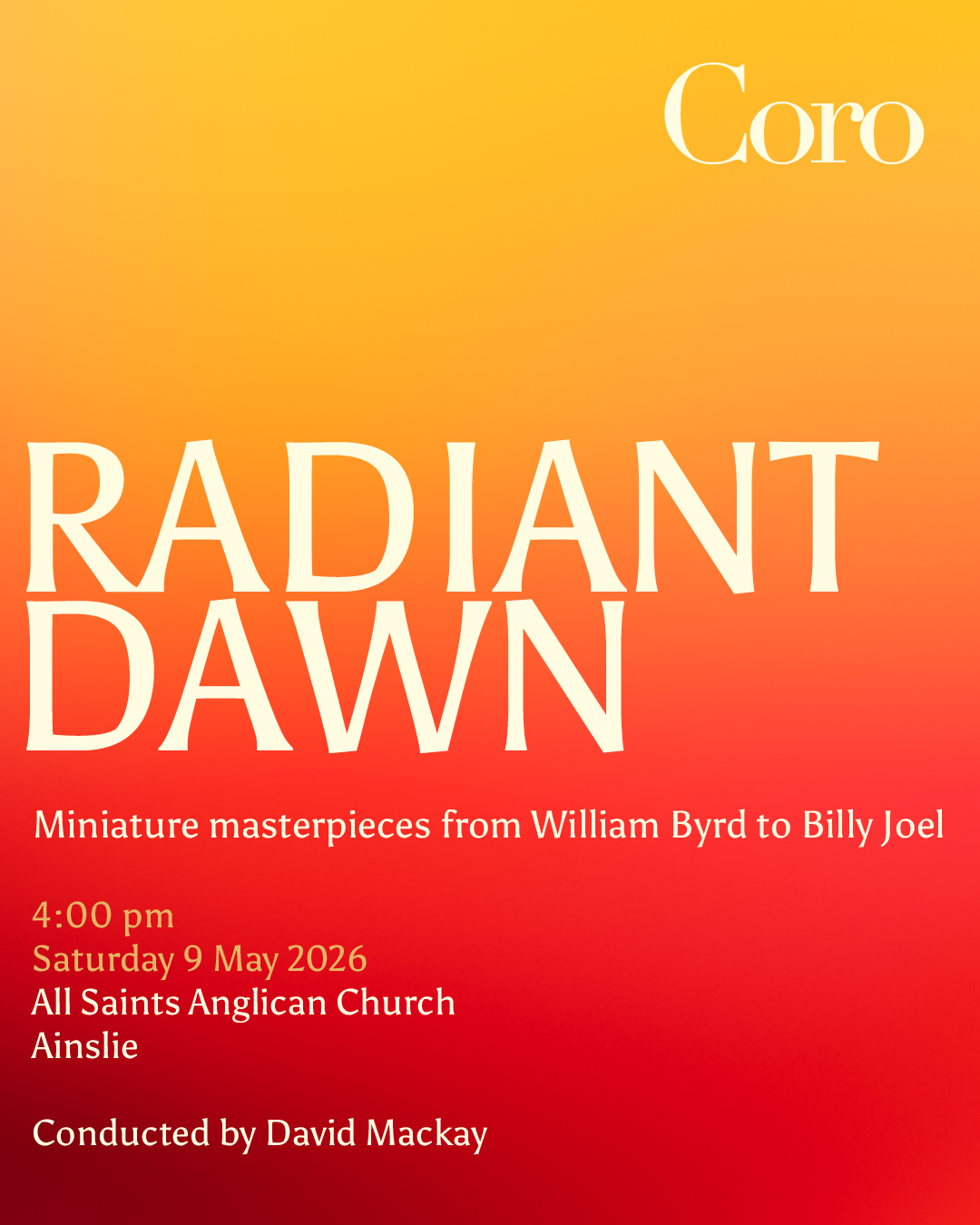
Coro, one of Canberra's leading choral ensembles and two-time Canberra Critics' CIrcle Award recipient, invites audiences to experience Radiant Dawn: From Lamentation to Light, an extraordinary hour of choral music that traces the path from sorrow and supplication to renewal, wonder, and radiant joy.
This thoughtfully curated program - the ensemble's first for 2026 - brings together masterpieces from the Renaissance and the modern era, revealing how composers across centuries have responded to the deepest human emotions with beauty, faith, and hope.
Beginning in stillness and grief with three great sacred works of the Renaissance by Handl, Victoria, and Lobo, these works explore mortality, sorrow, and the search for consolation. Yet from darkness emerges hope. William Byrd’s three exquisite settings of the Agnus Dei — for three, four, and five voices — chart a journey from intimate simplicity to glorious fullness of sound. Interwoven are Igor Stravinsky’s luminous Ave Maria and Claude Le Jeune’s joyful Revecy venir du printemps, suggesting grace, renewal, and the first stirrings of life.
At the centre of the evening, and giving the concert its title, stands James MacMillan’s breathtaking O Radiant Dawn, a contemporary choral masterpiece of glowing sonorities and spiritual intensity.
Celebrating life with energy, intimacy and warmth, the afternoon closes with works by Finzi and Chilcott, followed by Morten Lauridsen’s beloved O Magnum Mysterium.
Radiant Dawn: From Lamentation to Light is a concert of striking contrasts and deep emotional resonance — music that journeys through shadow into brilliance, reminding us of the enduring power of the human spirit.
Church Music Corner › 4th Sunday of Easter 2026 [loc-0044]
- April 26, 2026
- Liam O'Connor
Misericórdia Dómini plena est terra, allelúia: verbo Dei cæli firmáti sunt, allelúia, allelúia.
Today at All Saints Ainslie I was planning to sing Dering's Duo Seraphim as a duet with our choir director but he was exhausted and unable to come in for the morning mass, so instead I sang some Gregorian chants, specifically the introit for this Sunday in Latin (text above), the Easter Sequence in English using an older translation I remember from St. Mary's Cathedral (text below), and then the introit for last sunday:
Christians to the Paschal victim offer sacrifice and praise. The sheep are ransomed by the Lamb; And Christ, the undefiled, hath sinners to his Father reconciled. Death and life contended, combat strangely ended: Life's own champion slain, yet lives to reign. Tell us, Mary, what thou didst see upon the way. The tomb the living did enclose, I saw Christ's glory as he rose. The angels attesting, shroud with graveclothes resting. Christ my hope has risen! He goes before you into Gallilee. That Christ is truly risen from the dead we know. Victorious King, thy mercy show. Amen. Alleluia.
After that we had choral evensong for this month, this time directed by our usual director. We sang Stainer's Hail, Gladdening Light as usual, as well as Phillip Moore's third service for the Magnificat and Nunc Dimittis (it's hard to find good recordings). Because it was the day after Anzac Day, we also sang Daley's In Remembrance.
Do not stand at my grave and weep; I am not there, I do not sleep: I am a thousand winds that blow, I am the diamond glint on snow, I am the sunlight on ripened grain, I am the gentle morning rain. And when you wake in the morning's hush, I am the sweet uplifting rush Of quiet birds in circled flight. I am the soft stars that shine at night. Do not stand at my grave and cry, I am not there, I did not die.