Weeknotes 2026-W22 [2026-W22]
- May 31, 2026
- Liam O'Connor
This week I finally wrapped up my teaching obligations for Structured Programming. Just the final exam left to worry about.
The new papal encyclical [loc-004J]
- May 31, 2026
- Liam O'Connor
I have been reading and digesting in pieces the new encyclical from Pope Leo XIV, Magnifica Humanitas. While in some places I feel it doesn't quite go far enough, and the Vatican has troubling connections to Anthropic, I think that the content of the encylclical itself is very good.
One of the things that I always believed even while I was an atheist was the infinite worth of human beings. This aspect that underpins much of Catholic social teaching has always been one of the things I agree with, and part of why I find artificial simulacra of human connection, human relationships, human personality or human creativity so offputting and spiritually uncomfortable.
The Pope's new writing really rams home this foundation of Catholic social teaching with reference to AI. It's not really an encyclical about AI, but rather using the issue of AI to introduce folks to this teaching of the church.
There is also the more profound and important level of ontological dignity. This is the dignity that belongs to every human being simply by virtue of existing, of having been willed, created and loved by God. No sin, failure, humiliation or exclusion can diminish the profound value of a human life that God has willed and called into being.
Another aspect of Christianity that I really like is that it embraces love as a relation. We must express and receive love for one another to experience God. Without acknowledging others, embracing and accepting others, and loving others, we cannot be any nearer to God. Simply meditating or looking within oneself may clarify one's thoughts but it cannot bring us to love. Understanding and accepting human life, in all its diversity, including all its joys and difficulties, as something to be loved and experienced rather than suppressed or even transcended is a part of the Christian view, and something that I really appreciate. It seems like Leo agrees:
Even when limitations are experienced as inner suffering, human wisdom teaches us not to deny or suppress it, but to integrate it. To eliminate suffering entirely would mean, in the end, extinguishing love and desire as well. Those who love and desire cannot avoid passing through trial and suffering; and over the years, we carry within us lessons that leave their mark like scars, the memories of a journey shaped by freedom and failure, dreams and disappointments. It is only thanks to the interplay of these elements that the wonders of the soul occur within us, allowing us to sense the richness of our humanity. To renounce this adventure, both tragic and splendid, in the name of a presumed transcendence of all limits, could mean many things, but it would no longer be human.
He touches on many more topics, and I strongly recommend folks take the time to read it. I'll finish by just quoting one passage that seems to be sending a lot of LLM-poisoned idiots on twitter into a tizzy, despite being obviously correct:
So-called artificial intelligences do not undergo experiences, do not possess a body, do not feel joy or pain, do not mature through relationships and do not know from within what love, work, friendship or responsibility mean. Nor do they have a moral conscience, since they do not judge good and evil, grasp the ultimate meaning of situations, or bear responsibility for consequences. They may imitate language, behavior and analytical skills, or even simulate empathy and understanding, but they do not understand what they produce, for they lack the affective, relational and spiritual perspective through which human beings grow in wisdom. Even when these tools are described as capable of “learning,” their way of doing so is different from that of a human person. It is not the experience of those who allow themselves to be shaped by life and grow over time through choices, mistakes, forgiveness and fidelity. Rather, it is a form of statistical adaptation based on data and feedback, which can be very effective, but does not imply inner growth.
Church Music Corner › Trinity Sunday 2026 [loc-004K]
- May 31, 2026
- Liam O'Connor
Benedícta sit sancta Trínitas, atque indivísa Unitas: confitébimur ei, quia fecit nobíscum misericórdiam suam.
Caritas Dei diffúsa est in córdibus nostris, alleluia: per inhabitántem Spíritum eius in nobis, allelúia, allelúia.
Today at All Saints Ainslie our choir absolutely nailed the performance of William Byrd's beautiful and heartbreaking setting of Ave Verum Corpus
Ave verum corpus natum de María Vírgine, Hail, true body, born of the Virgin Mary, Vere passum immolátum in cruce pro hómine, True suffering, sacrificed on the cross for Man, Cuius latus perforátum unda fluxit sánguine, From whose pierced side flowed waves of blood, Esto nobis prægustátum in mortis exámine. Be for us a foretaste in death's trial. O dulcis, O pie, O Iesu fili Maríæ, O sweet! O blessed! O Jesus, son of Mary, Miserére mei, miserére mei, miserére mei. Have mercy on me, have mercy on me, have mercy on me.
This Thursday is Corpus Christi, but I'm flying to Brisbane so I won't be able to make any observances this year, and Ainslie doesn't do anything in any case.
Also, this Saturday our choir is doing a concert with instrumentalists from the Burgmann Anglican School in Gungahlin.
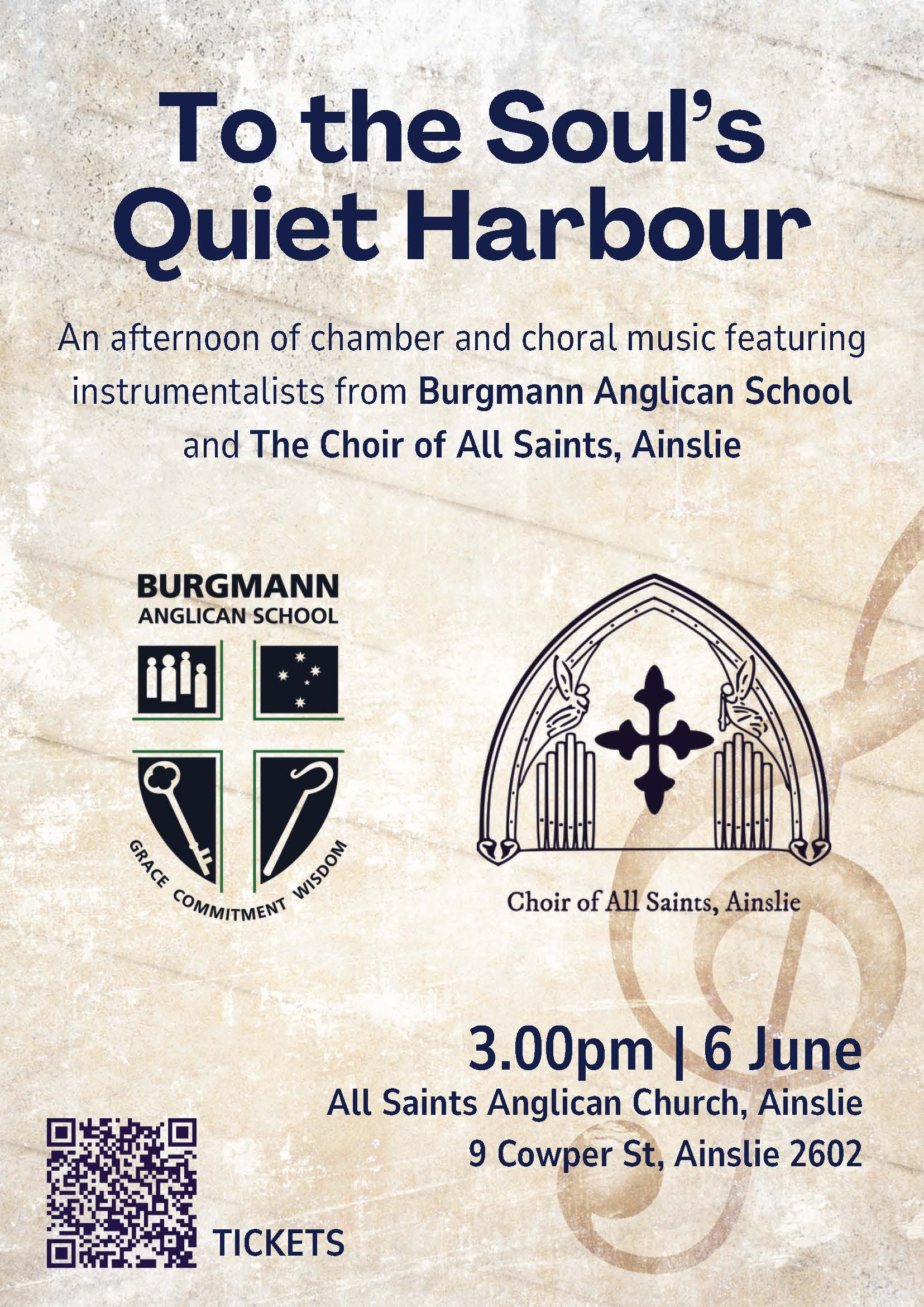
The instrumentalists will perform a variety of pieces interspersing our performance of (the first four of) Parry's Songs of Farewell, finishing with us all performing some Ralph Vaughan Williams.
Do come down to All Saints Ainslie and support our music fund!